Featured Case Study
Turning Feedback into Growth
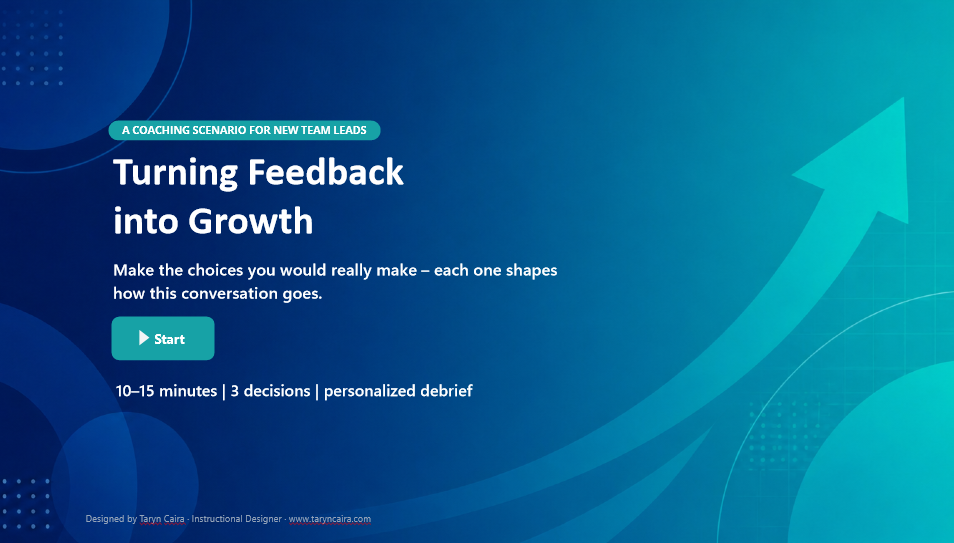
A branching coaching scenario that lets new managers rehearse one of the hardest conversations they'll ever have — with consequences, coach's tips, and a personalized debrief.
Learners step into a 1:1 with Jordan, a usually-strong analyst whose work has slipped, and make three realistic decisions: where and when to raise the concern, how to open the conversation, and how to respond when Jordan gets defensive. Every choice opens consequence feedback with a coach's tip; a running score drives a personalized debrief.
Articulate Storyline 360 · 10–15 minutes · New managers & team leads
Audience
New managers and team leads, 0–12 months in role.
Format
Self-paced branching scenario, 10–15 minutes, with scored decisions and a personalized debrief.
Tools
Articulate Storyline 360 — slide layers, variables, conditional triggers, text-to-speech narration.
The Challenge
The Problem
New managers rarely fail at feedback because they don't know the theory — they fail in the moment, under social pressure. Common failure patterns are predictable: catching someone off guard in a hallway, judging character instead of describing behavior, and shutting down defensiveness instead of working with it. A slide-turner or an info page can't rehearse those instincts; only decisions with consequences can.
The design challenge: build a scenario where the wrong answers are realistic (well-meaning, not cartoonish), feedback teaches rather than punishes, and learners can explore alternate paths without the course ever feeling like a test.
The Design
The Solution
Learners step into a 1:1 with Jordan — a usually-strong analyst who has missed two deadlines this month. The course maps four action-level objectives to three branching decisions:
- Identify the appropriate setting and timing for a feedback conversation (Decision 1)
- Distinguish behavior-focused from person-focused language (Decision 2)
- Respond to defensiveness with acknowledgment plus collaborative problem-solving (Decision 3)
- Reflect on personal feedback habits and commit to one improvement (debrief + reflection)
Each decision offers three options scored 0 (weak), 1 (acceptable), or 2 (best). Every option opens its own feedback layer explaining the consequence and offering a coach's tip — and learners can close any feedback card and try another option before moving on. A running score (max 6) drives a personalized debrief with three possible summaries, followed by an un-scored reflection prompt.
Setting & Timing
It's 4:15 PM and Jordan is refilling coffee, visibly stressed. Pull them aside now, book a private 1:1, or send an email?
The Opening
"Your attitude has deteriorated," a specific behavior statement, or a vague "everything okay?" — which opening invites dialogue?
Defensiveness
Jordan pushes back: "Requirements kept changing mid-sprint." Dismiss it, acknowledge and co-own a fix, or shut it down?
The scenario closes on a hopeful turn — the manager and Jordan agree on a process fix — reinforcing that feedback starts a cycle rather than delivering a verdict.
Design Decisions
The Process
Consequences, not verdicts. Wrong choices never gate progress. The feedback layer is the teaching moment: a specific explanation of why the choice backfires, plus one actionable tip. Learners can retry any decision before committing — and only the option they continue from is scored, so exploration stays consequence-free.
A score that means something. The score isn't a grade — it's personalization fuel. Three mutually exclusive debrief bands (5 or higher, 3–4, 2 or lower) ensure every learner gets a summary written for how they actually performed, ending in one concrete improvement habit.
Silence where attention matters. The three decision screens are deliberately unnarrated: learners must read three options and choose. Narration carries the story slides and every feedback layer, where a coaching voice lands hardest.
Transparency of goals. Objectives are shown up front, and the reflection slide explicitly tells learners their answer isn't scored — modeling the psychological safety the course itself teaches.
The build surfaced several real problems worth documenting — the debugging stories below are as much a part of the piece as the finished product.
Layers vs. slides. My first build separated feedback states into individual slides. Restructuring to slide layers (three per decision slide, three conditional debrief layers) preserved the single-slide context that makes "try another option" possible, and made conditional debrief bands possible at all — a slide can't conditionally be three different slides, but layers can.
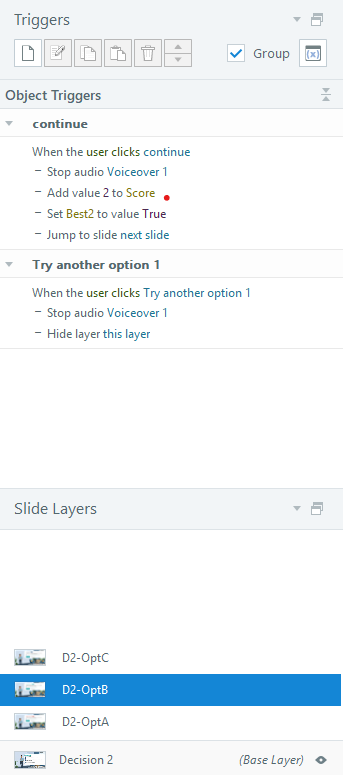
Trigger scoping. Two subtle scoping rules shaped the architecture: layers are targeted by a different action (Show layer) than slides (Jump to slide) — they never appear in navigation dropdowns — and media controls only see audio on the timeline they're built on. Several early trigger bugs came from picking the wrong action family or building a trigger from the wrong scope.
Trigger ordering. When one button carries several triggers, they fire top-to-bottom. My Continue buttons originally jumped to the next slide before banking the score, silently erasing correct answers; reordering scoring triggers above navigation fixed it. Same fix later applied to media-stop triggers above hide-layer triggers.
Narration overlap. After adding text-to-speech narration, clicking through before a clip finished produced overlapping voices. The root cause was architectural: audio on a base layer can't be stopped by triggers built on its child layers, and pausing a base timeline only resumes it later. The fix was a rule, not a patch: no narration on any base layer that hosts narrated layers — voices live only on the feedback and debrief layers, each controllable from its own timeline.
State memory on replay. The Replay button returned learners to Decision 1 with the last-opened feedback layer still showing. Slide-level "reset to initial state on revisit" behavior, plus variable resets, restored a clean slate.
Technical Notes
The Build
- 10 slides · 12 slide layers · 4 project variables (Score, Best1–3)
- ~30 triggers: navigation, show/hide layer, conditional variable-based layer display, media control, and state resets
- Text-to-speech narration using Articulate's built-in engine; captions plan for accessibility
- Published for web distribution; embedded on this portfolio site
- Built during the Articulate 360 free trial — published output carries the trial's "Powered by Articulate" badge
- Illustrations AI-assisted; art direction, prompt design, integration, and all instructional design by me
Live Demo
Play the Course
The full branching scenario runs below — or open it in its own window for a larger view. Make the choices you would really make; each one shapes the debrief.
Evaluation
Results & Reflection
This portfolio piece was built as a design and development demonstration; it has not yet been piloted with a learner audience. The evaluation plan below describes how its impact would be measured, framed on the Kirkpatrick model.
Level 1 — Reaction. Post-course survey (3 questions: relevance, confidence to apply, anything confusing) with a target of [X]% rating the scenario "realistic" or higher. The course's built-in reflection prompt doubles as a qualitative reaction measure — learners describe their own avoidance pattern in their own words.
Level 2 — Learning. The scoring system provides built-in measures tied directly to the objectives: the distribution of final scores across the three debrief bands (a healthy first-run pattern would cluster in the 3–4 band, showing learners can recognize good practice without yet executing it perfectly); the Best1–3 choice flags reveal which of the three objectives is hardest — the design prediction is Decision 2 (behavior-focused vs. person-focused language); and the completion rate of the reflection prompt indicates engagement with the self-assessment objective.
Level 3 — Behavior. A 30-day follow-up pulse to pilot participants (one question: "Have you used any of the three moves — private setting, behavior-focused language, acknowledge-then-solve — in a real conversation?") would approximate transfer to the job, the measure the scenario is ultimately designed to serve.
What I'd take into the next project: the layers-over-slides architecture and the banking-on-continue scoring pattern are directly reusable; the narration scoping rule (voices live where they're controlled) belongs in every audio spec I write; and testing trigger order — not just trigger existence — is now a permanent item on my QA checklist.
What I'd do differently: I'd wire the conditional debrief triggers earlier — building the debrief last meant several fixes rippled backward. I'd also script narration against layer timelines from day one instead of retrofitting.
Visual Evidence
Selected Artifacts
A closer look at the published course and the trigger architecture behind it.
Let's Connect
Interested in how I design for decisions, feedback, and learning transfer?
I'm always excited to build learning experiences that let people practice hard conversations safely — and to document the thinking, not just the output.